

My minty breath ascends, softly and quickly as if reminding me I never owned it–I was just keeping it warm.
My minty breath ascends, softly and quickly as if reminding me I never owned it–I was just keeping it warm.
They say you can’t put the genie back in the bottle, but I’m going to try.
I probably stare at my phone (or my laptop screen [or my TV screen]) upwards of 8 hours a day. I should check that number. They have apps for that now.
Like any great illusion, I can’t quite remember at what point my attention diverged from reality to distortion. It’d help if there was a revertible version we could flip back to to remind ourselves: an alternate reality without these alternate reality digi-verses we’ve ironically dubbed “social.” But we don’t have that luxury.
We’re here now, in the throes of irreversible cancer we’ve inflicted upon ourselves. Instagram, Twitter, Snapchat, TikTok, Facebook, et cetera — these things all have names but no faces. They’re too big to identify. They’re too big to die. Critical mass remains tucked behind the horizon, and I’m not sure when it might appear, if ever.
The symbiotic relationship between an infection and an infected population is always further complicated by considerations of intelligent design. For instance, it’s an inherent feature of religion; I believe in god, and I believe god created all, therefore I believe god created plague. This is followed by the inevitable question: Why did god create plague?
Agency is an unavoidable curiosity, but only for trauma, it seems. We are all more than content to receive blessings and spare no thought on its origin or creator, if there is one. That is an inherent feature of humanity.
There are lots of plagues today, too many to count. There is the obvious one, the pandemic. Buzzing around it like a swarm of locusts so densely clustered as to be indistinguishable from a dark storm-cloud are infinite afflictions of the mind. There are people that see disease and crippling fear in places they did not before. There are people that refuse to see it at all, who through aforementioned tailormade misinformation addictions believe it all to be a lie. These are both sicknesses.
There is no panacea. Our symptoms — environmental catastrophe, codified racism, devastating food insecurity, rampant mental health crises — cast too broad a net. But there is one malaise at the root of it all, and it is generally good practice to treat the severe symptoms while focusing on curing the disease.
Why can’t the world’s most prominent so-called leaders and organizations solve any of these issues? Why does it often seem like it is in their best interests not to? Because truth has imposters now, and with astounding negligence (another inherent feature of mankind) we have invented brilliant and insidious operating systems that render these imposters both highly profitable and indistinguishable from what is true. That’s not “capital T” truth. The truth I’m referring to is as basic and objective as having a consistently reported death toll for a pandemic.
We have designed these little nodes for ourselves with panoramic, unbreakable windows, all in the name of technological advancement, and the illusion is not that there isn’t a barrier, but that we shouldn’t want to leave at all. Everyone I know is in here. Better to stay inside.
Like any great illusion, there is an element the audience is invited to solve, an ego-satisfying red herring to lull us into a false sense of intelligence. We imagine we’ve discovered a way to proxy the trick, and if it passes our firewalls, it must be magic. This is, of course, by design. The magician wants us to have this. It legitimizes how they plan to embarass us, and it shrouds the actual and entirely non-mystical trick itself.
So, here’s the real trick as I see it; InstaTwitterSnapTokFacebook is our node with the panoramic windows. We think we are surrounded by friends, but they are just numbers. We think we are touched and loved because we are “liked.” We think we are connected, but many of us have not even met each other yet. Many of us will live and die as holographic projections meandering around each others’ node, trading memes in the spirit of “communication.”
It is a cruel trick. The illusionist has given us everything we thought would make us feel together, yet we are eminently alone. Our nodes are so carefully curated to what we desire that they have become our reality, and reality as was previously agreed upon has become illusory and fractured in turn. Again, I wish we could return to the way things were, even if it were just for a moment, just to remember how it felt, but it’s too late. What a cruel trick we, the illusionist, have pulled on ourselves.
How am I going to put the genie back in the bottle? It is everywhere, granting curses disguised as wishes. I don’t think it’s possible, but doing more of this is a good start.
It’s been so long since I’ve used a pen, I can’t remember what my handwriting used to look like. How did I hold this thing before? What did I write about? What did I think about? What made me angry? Who was I? I was a scribbler, I think.
I have a weird feeling I’ve drifted really far away from some place, some island with no one on it. I think I was born there, grew up there, was stranded there. Can’t say how long. There was no one to keep record of my time on the island. No one to remind me if I was ever there at all. I dream about it sometimes, but when I wake up it’s gone — nothing but the smell of water and a few grains of sand in my hair I can’t seem to wash out. I belong there, I think. Whatever I’m looking for is back on that island, but I refuse to go back alone, and now I’ve forgotten the way.
The first thing I ever wrote was for my eighth grade English class. Mr. Munson, who spoke in Arthur Miller platitudes and wore funny ties, handed me a blase introductory worksheet. I think everyone else wrote about college or something. I (over)wrote some Dead Poet Society nonsense about feeling like I’ve been trapped at the bottom of the ocean my whole life with a 10-ton anchor shackled to my feet. I wrote about how every time I spoke, screamed, cried or laughed it always felt the same: bubbles rising to the light, dissipating before they could break the surface. It was the most honest thing I’ve ever written, and it was terrible, full of unjustified angst and bombastic prose.
If I close my eyes and take a deep breath, I can just make out what my handwriting used to look like. I’m relieved but simultaneously disturbed to know that it looks almost exactly the way it does now. Who did I think I’d be at 26? What did I want to grow out of? What parts of me did I hope I wouldn’t lose?
I really can’t remember.

I am deconstructing my dehydrated flowers to display them in an empty, glass tequila bottle. I am listening to ICAROS while tripping mushrooms in my room in Chicago, IL. I just laughed at the thought of reading this later. I don’t reflect on things enough anymore.
Sometimes, it’s good to just record. And watch the spaces fill themselves. Observation is life. Thought is quiet. Stillness is symphonic.
Editing is such an insecure task. It’s this idea of not wanting to sound like yourself, wanting to shape Earth into sculpture, but what’s more beautiful than Earth? It abounds, we’re just taking petals from the flower before they’re dead. When we edit, we’re questioning our own way of thought. We make ourselves the other. We make the self foreign.
I’m hungry.
The trip has gone over the Hill. Thoughts are beginning to coalesce once again, streams into rivers. I’m beginning to remember who I thought I was, and now who I want to be. It’s strong. It’s ancient. I can remember millennia past.
This will go un-edited. I have never done this before, complete stream of consciousness. I recognize the humor and satire in this. All the thoughts start with the Self. There’s a part of me that wishes the trip to be over, but this is foolish and fearful and irrational. I should hope to hold onto this, as I will long for these thoughts later. Do not delete yourself.
I miss profundity. I used to find it in everything. Now I am ashamed of its unabridged nature. I choose to dip in and out of its stream, shocked at how hot it is.
The trip is not over, and I am delighted. I think when I’m scared to trip, it’s because I think it’ll cause a disruption in my life. It’ll make me something I wasn’t before, and if I like that thing, I don’t want to lose it. But tripping helps me remember. That I was only that thing one time, a long time ago, and I’ve been a billion other things since.
I hope I read this tomorrow.
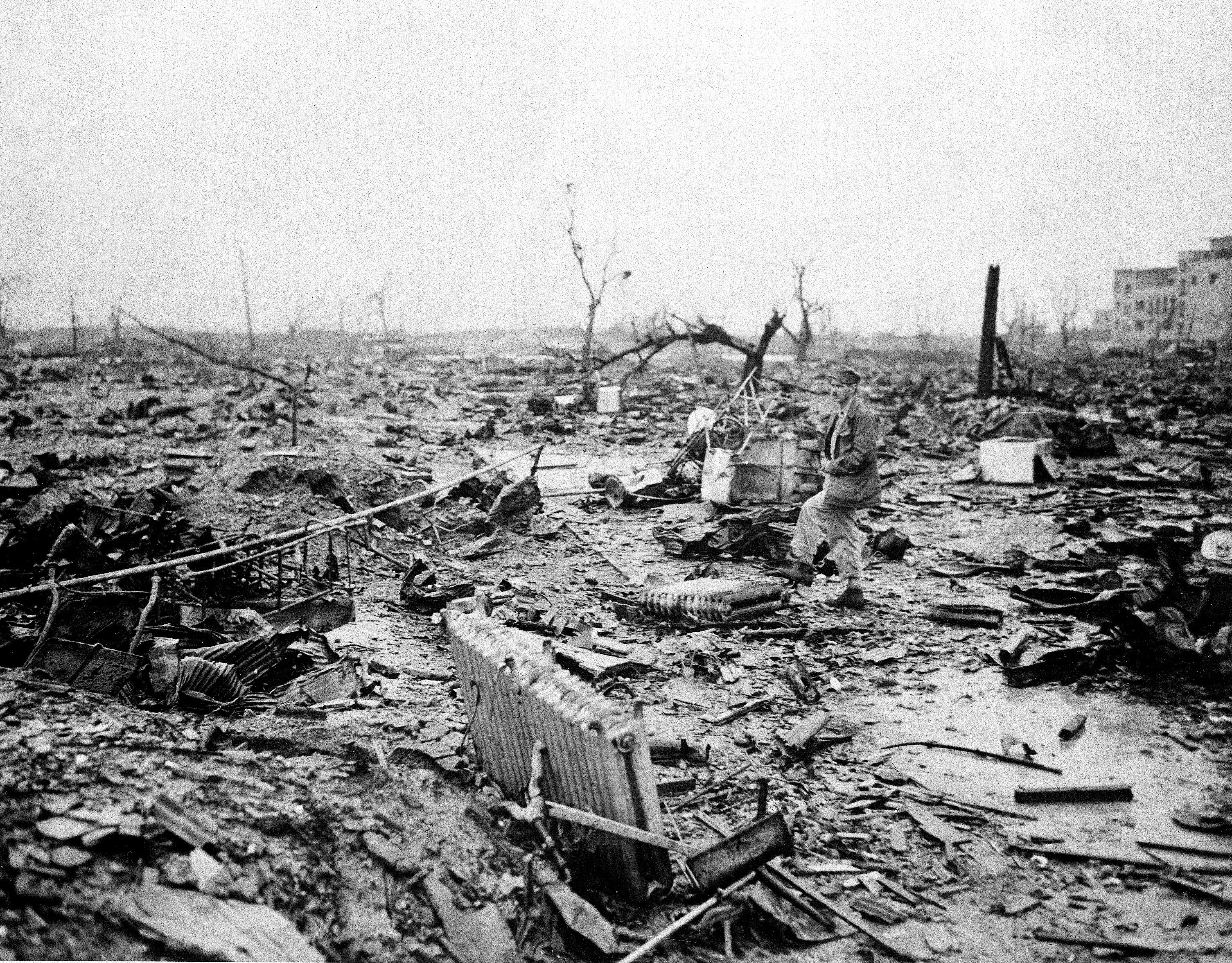
Unbloomed twists like charcoal spines of a smoke colossus
engulf a little mountain town by the water,
Streets young, naked, childlike.
Splintered rain breaks dawn—
BOOM.
Black snow flitters through the air/Violent Coalescence/Ashen Equilibrium/
Tatsoi Cabbage/Concrete Shadows/Rows and rows/All charred and black/
What if God is just a boy that left his toys lying around for us to destroy?
What if He died in the blast, too?
Who’s gonna pick up the burnt plastic?
—Sweeney “Sweets” Robinson, slumped over the table, former United States Army Air Force pilot, wakens to an oracle lining up his umpteenth shot. Snort floods to the brim. Whisky slides across the countertop and clinks against America’s forehead, spilling into his eyes.
“Wake up, Sweets,” the bartender says.
Don’t I know you from somewhere?
“You don’t know anyone, Sweets. But you’re the only one left in this place, and you’re running up a tab. Take your shot and get the fuck out.”
Sweets looks around. The Place is indeed empty. He raises Last Call, brown and vicious, and thumps it down—
Like melted rubber.
They looked like melted rubber on the pavement.


Lemme see ’em, Annie. Please.
Sweets swigs from his slosh. The lamp on the front porch swings loud as soft.
Annie gets a good look at him — eyelids trapped in soot, the kind you can’t wash — and wonders how he got so old in so little time.
“You don’t live here anymore, Sweets. Go home. You’re gonna scare them.“
This is my home.
He smears whisky off his lips. Annie wraps her shawl a little tighter, a closed cocoon; it’s cold in Lowell this time of year.
“You’re unwell, ain’t ya? I can smell you. Come on, let’s go down to the Pit. I’ll start a fire. We can talk there.“
We can talk right here. I’ll be civil, Annie, swear. Hand to whoever people prayin’ to nowadays, I won’t be a bother. I just wanna see my own.
“Settle yourself. You can’t be showing up like this unannounced and such, Sweets. What are they gonna think? Seeing you in a state like this? Come back tomorrow, when you’re reasonable.“
Sweets hurls his bottle at the ground. It splinters into an infinite, boozy fractal, all over the porch.
Who (burp) who’s the unreasonable one here? Have you lost your damn mind? We’re on the brink of annihilation, Annie. It’ll all be over tomorrow.
Melted rubber, streets leveled, dark countours painting the last moments of a million people: it all looks so goddamn unnatural in his head.
You really don’t get it. Do you? This time tomorrow we’ll all be dust. This house. All of us. This ain’t no war. After what we did—after what I did—they’re gonna respond. They’re gonna retaliate. And when they do…
Sweets points to the sky.
…there won’t be no one left.
Annie looks at him and just can’t believe how old he got in one day, with the press of one little button in a plane, miles in the sky over some Japanese city he could barely see beneath him.
Fine, you want me to beg? I ain’t too proud to do it.
I’ll beg.
Sweets kneels like a sunset but all twisted-like — charcoal spines of a withering ghost, once proud and free and brave and stupid and hopeful and American — praying for his Armageddon. He waits for Someone to smite him where he is, wiping him and his sins off this plane of existence like swatting a fly.
He doesn’t know Armageddon already passed him by, with the press of one little button in a plane, miles in the sky over a city of radioactive angels he’ll live amongst for the rest of his days.
“Look, everyone knows what you did, Sweets, and we thank you for your service–“
Don’t say that. You don’t know what you’re talking about.
Sky bursts, and morning trickle turns into downpour. Sweets’ knees, all cut up from the broken bottle, open up a highway of sakura syrup streaming down the wooden steps.
“All that’s happened to you … being on the side of history you think you’re on … I can’t fathom that. And I wouldn’t dare tell you how to live with that. But baby … this is not your home anymore. We haven’t seen each other since before the war.
And the world’s not ending tomorrow, no matter how much you wish it would.
It’s gonna turn
and keep turnin’
and you’re just gonna have to come back tomorrow at a decent hour … when you’re reasonable.“
She shuts the door on him.
Hey. Hey! Don’t be like this!
Annie!
Sweets slips and falls backward
off the porch and onto the grass
landing softly with a thud
into nuclear nothingness
a spirited seppuku.
ANNIE!
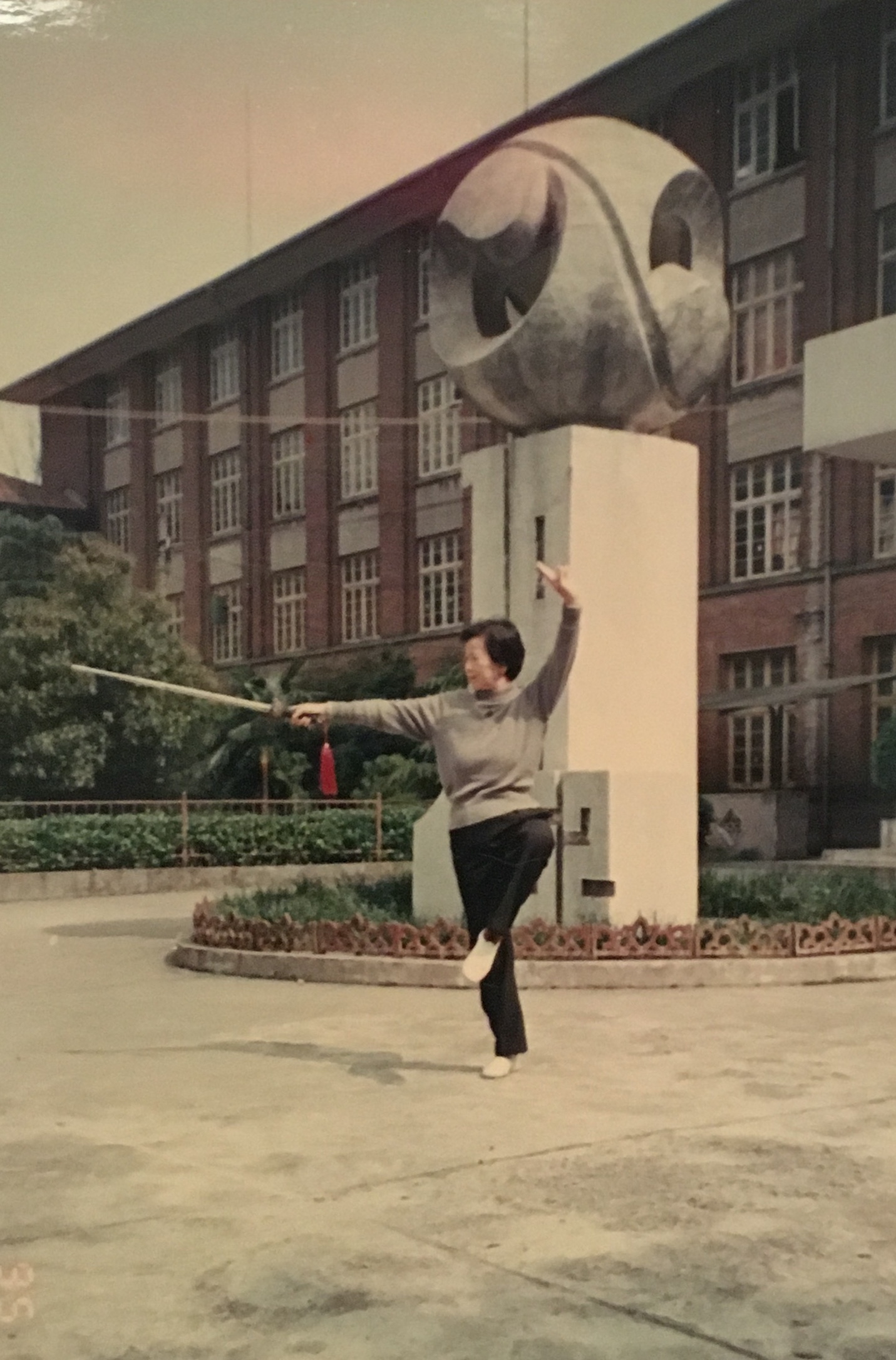
I have a tattoo that goes all the way down my spine. It’s a strip of Ancient Egyptian text that reads:
“Oh, heart that is in the house of hearts, I have my heart and it is pleased.”
It’s been over two years since I got it inked, and I’m still not sure what it means to me. But the memory of reading those words for the first time is still crystal clear. Walking through the black-vinyl rooms of the ‘Egyptian Antiquities’ exhibit in the Brooklyn Museum, I saw it – a frayed scroll about twenty feet long, rolled out onto a bed of white lights illuminating the markings carefully brushed onto the papyrus:
“Oh, heart that is in the house of hearts, I have my heart and it is pleased.”
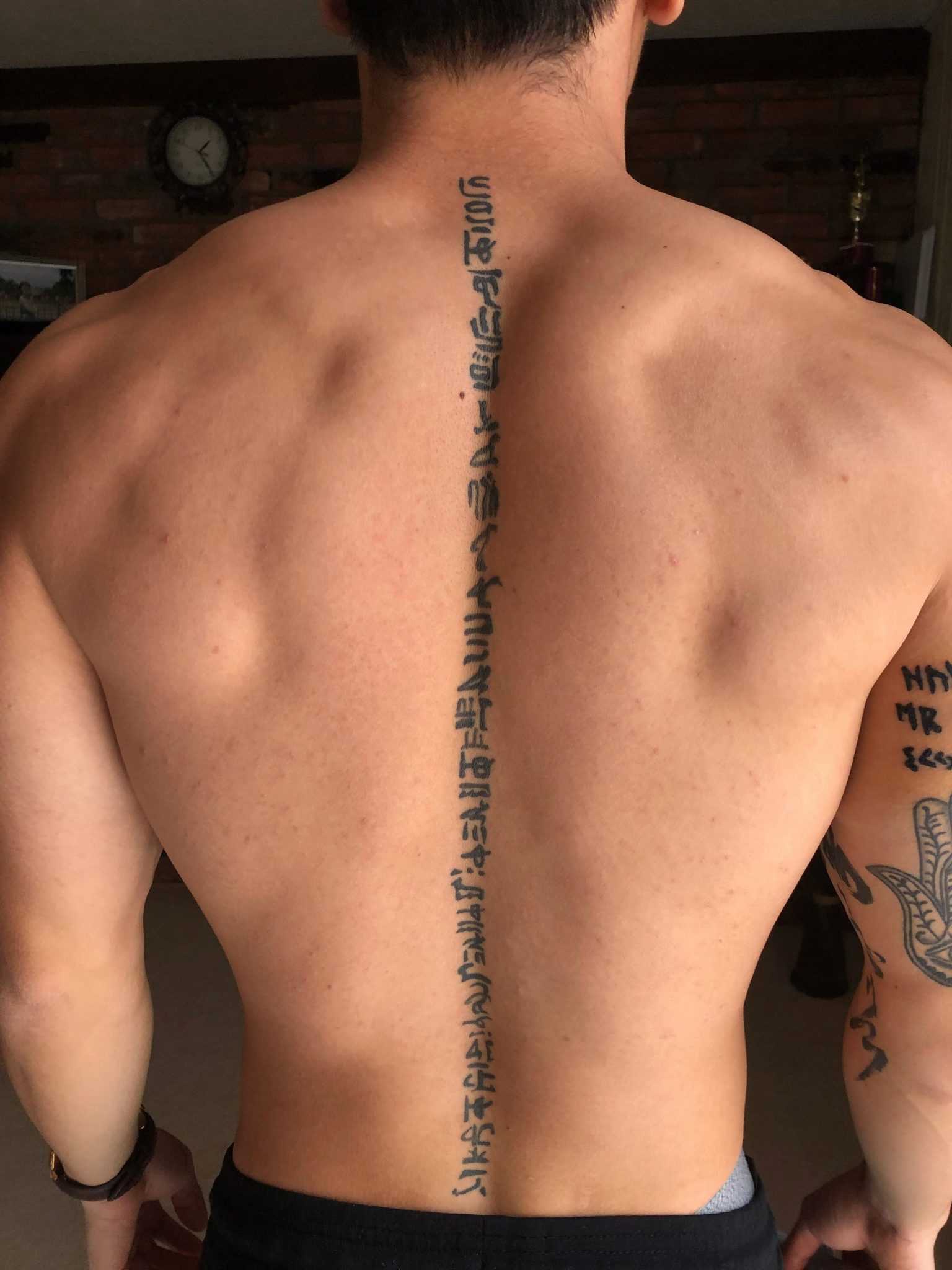
My grandma died last month, and I’ve been thinking a lot. Mourning a little, but thinking all the time. It’s sad to think she won’t be around on this Earth anymore. It was hard to watch her go through those final days, with the pain she was in and the way a nest of IV bags can make someone look so weak. She wasn’t weak. She was the strongest person I knew. Yeah, I’m sad but I mostly just wonder.
At certain points of my childhood, she and my grandpa looked after me when my parents were working. She had an infectious laugh and a deceptively dark sense of humor. She was stoic. She could be unforgiving. She had the softest hands. She taught me one of my favorite breakfast recipes – a simple porridge made up of Bok Choy (Chinese Cabbage), rice, chicken broth, and salt. I could never do it the way she did it.
That porridge is kind of how my grandma lived her life. She was a woman who couldn’t care less about wealth, in all its forms. She didn’t give a damn about the approval of others. Money was only currency for her. Even romantic, spiritual riches carried very little weight. You could see the handful of values – compassion, unconditional love, family, sacrifice – that mixed to make her who she was. Like her porridge, grandma held the simplest things in the highest regard.
I didn’t know her very well. She spoke very little English, and my Chinese wasn’t fluent enough to have a deep conversation with her. But I know how she lived. I know how much she meant to her son, my father. She raised him with the highest expectations, not of worldly success but of virtuous triumph. And she was no hypocrite. Grandma always walked the walk, and very rarely talked at all.
The source of my tattoo comes from “The Book of the Dead, of the Goldworker of Amun, Sobekmose.” In Ancient Egypt, people were often buried with a book of spells to carry with them into the afterlife. Some of those spells were for improving quality of life in the next world; Sobekmose’s spell was for improving quality of happiness.
“Was my grandma a happy person?” That’s been on my mind through this whole process. I’ve never met anyone more unflappable, more indomitable; the only time I ever saw her cry was on her deathbed. Maybe she wasn’t happy all the time, but she was always joyful. Life was good even when it was bad, and she wouldn’t let anyone change her mind on that. She insisted on being joyful. That’s how I want to live my life. I don’t want to be happy all the time, that’s a pipe dream. But I want to enjoy the little things. I want to make sure the day never comes that I can’t taste every flavor in the bowl.
So, here’s my porridge recipe:
Everything extra is just that: extra.
I think my grandma’s passing would have been a lot worse if my family and I weren’t so sure that she’s alright. We know, with absolute certainty, that wherever she is she’s exactly the way she was. Grandma built a house of hearts with us, through us. A few weeks ago, she took her heart with her on her next journey. I know she is pleased.
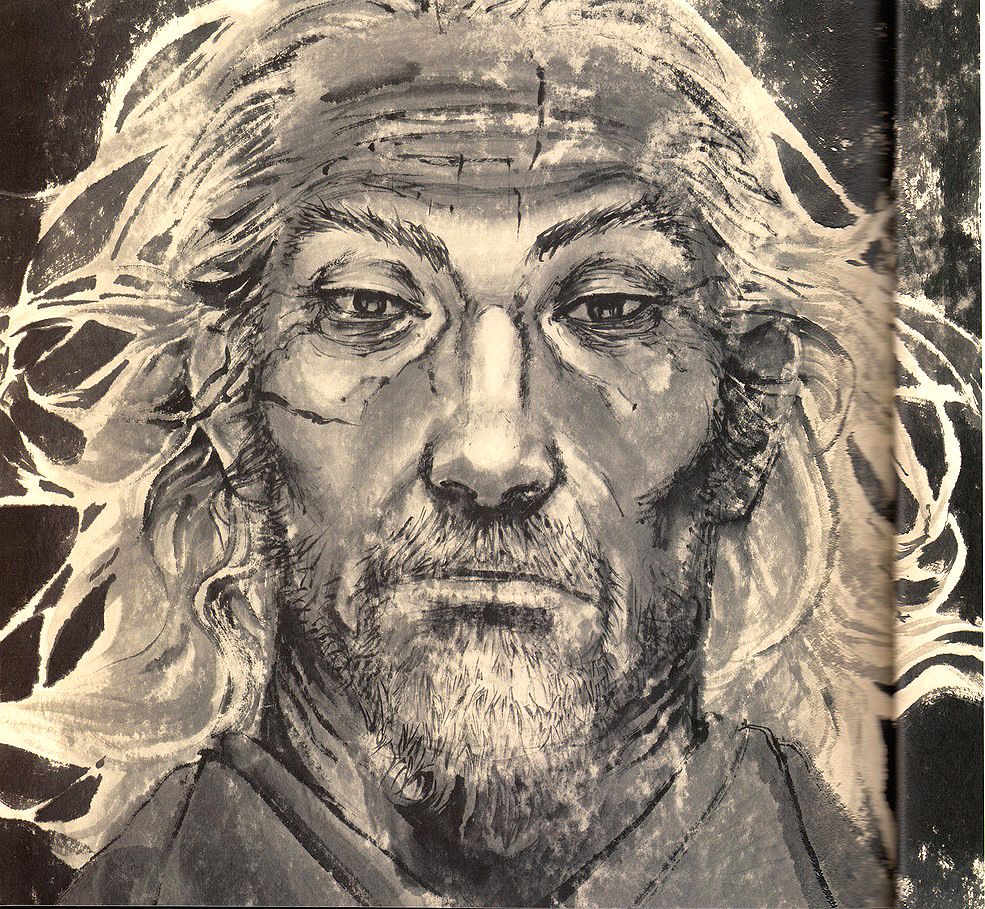
A traveled man holding a canvas and a few paintbrushes traipses towards the Reigando Cave. As his wooden sandals shuffle through the sand, drops of dew fall from the rockface above him, mostly merging softly into the ground. One slices through the air, bursting onto the old man’s hair — which sits atop his head unruly and wild like a burning thistle in the desert. The old man looks up.
He closes his eyes, taking in a deep and vast breath. Another droplet tumbles through the air, locked onto a direct path to his forehead. Just as the water threatens to splash across his face, the old man exhales sharply. The droplet sprays through the air, exploding in all directions, all ways of movement.
The man holds his hand out, palm facing him, and descends into the cave with a pace as steady as the Okinawa tide in wintertime. He walks until the light behind him has faded, until he can hear the sound of those chilling waves colliding ashore, water dancing with sand before pulling away like a widow’s lost embrace. It’s only the echo of the cave and his ears, of course. He walks until he can’t see his hand anymore.
It is here, in the pit further than darkness that the old man puts down his tools. He props up the canvas in front of him. He sets down his brushes and his ink tray. Then, he sits and he starts to paint.
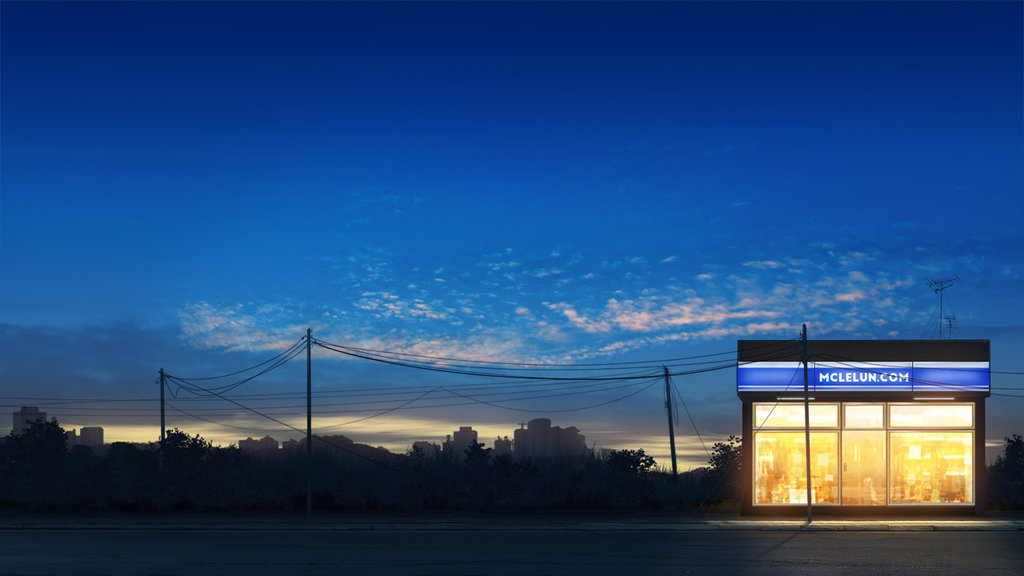
The air tastes stale in the shop. Alice scrawls a few lines down in her notebook, keeping an eye on the register during the dead hours of her shift–
the store exhales. Dust.
plastic mitochondria
tending to its shelves.
–The doorbell chimes open, and suddenly the smell floods her senses: sinewy, tender, flush. She can’t help but stare at the glow, the pink hue of skin radiating straight from the Human to the pit of Alice’s stomach. Radioactive bloodlust strikes a symphony in her and she can only think of one word–
Life. The Human, a fair-skinned woman with red tresses flowing past her shoulders, floats through the drink aisle. She runs her fingers along a row of glass Coca-Cola bottles; streaks of water linger where she last touched them. Alice realizes she has followed the Human down the aisle.
“Hi,” Alice blurts out.
“Hey!”
“Let me know if I can help you find anything.”
“Okay, thanks!”
Alice spins around, and if she had blood to spare it would have all gone to her head by now. The hair on the back of her neck stands up with little fortitude, like spindly trees desperately fending off the full force of the wind. “Could be the cooler,” she lies to herself.
“Just, uh, holler if you need anything!” Alice says with a strained smile.
The Human nods. Alice turns back to the register. The air in the shop doesn’t taste so stale anymore. There’s something seeping through its pores now, gnawing at her:
Hunger.
“Actually,” the Human calls out. Alice freezes. “Do you guys have, um, I don’t know what I’m really looking for,” the Human trails off mid-sentence, and approaches Alice like a minnow swimming up to a shark.
The Human twirls her fingers around the aluminum cap of a liter of sparkling water. She looks Alice dead in the eyes, loitering in her abyss.
“I know what you are,” the Human whispers. The bottle of water crashes to the floor, shattering all over the place. Its shards bubble at the edges, hissing faintly like a serpentine choir.
“Why did you do that? That’s–someone could have bought that.” Alice asks the Human.
The Human leans in and kisses Alice, and the hair on the back of her neck gives in, falling limply to their roots. Alice pulls away, and for just a moment, fire and ice, accompanied only by the fizzling water under them and the hum of coolers around them, dance among one another. Neither extinguishes the other, into neither gas nor blood.
Then Alice takes her first bite.
“Oh my god, I’m sorry, I’m so sorry.” The words, both hollow and sincere, ooze out of Alice’s bloody mouth.
The Human smiles. “Do it again.” She throws another bottle onto the floor. Alice takes another bite, this time drinking in the sight of the Human’s thick, red hair. Alice wonders how anyone could be so thoroughly ablaze with heat without disintegrating into ash. Is this what the burning bush would have tasted like?
She finishes the Human. The water on the floor runs dark and moves slowly. It has stopped fizzing. Alice sees what she has done. The Human, now lifeless, looks like a painting; watercolor splotches stain her white summer dress, and her face remains frozen in ecstasy.
Alice speaks softly, “Thank you.” She stoops down to shut the Human’s eyes–
“Alice!”
Alice snaps out of her strange daydream.
“Earth to Alice!”
Randy, a neckbeard in his mid-40s, stands before her waving a broomstick in front of her face. “You dropped a bottle of Gerolsteiner. Clean it up, someone could have bought that.”
Alice scans the store. There’s no one in there but the two of them. She takes the cleaning supplies in, and sweeps up the broken shards into a black, plastic trash bin.
I’ve never been good at poetry. Just not my thing.
Something about haikus interests me, though. They’re only three lines and 17 syllables total, with a 5-7-5 syllable pattern. Which is another way of saying they don’t take long to write and offer such a simple structure that even my little pea brain can do them; there’s a reason many elementary schools practice them in English class. Despite their bareness, though, great haikus carry endless depth.
The first cold shower
Even the monkey seems to want
A little coat of straw
- Edo period Japanese poet Matsuo Bashō
I’ve tried to write at least one haiku every day for a month now. Here’s a few I don’t hate.
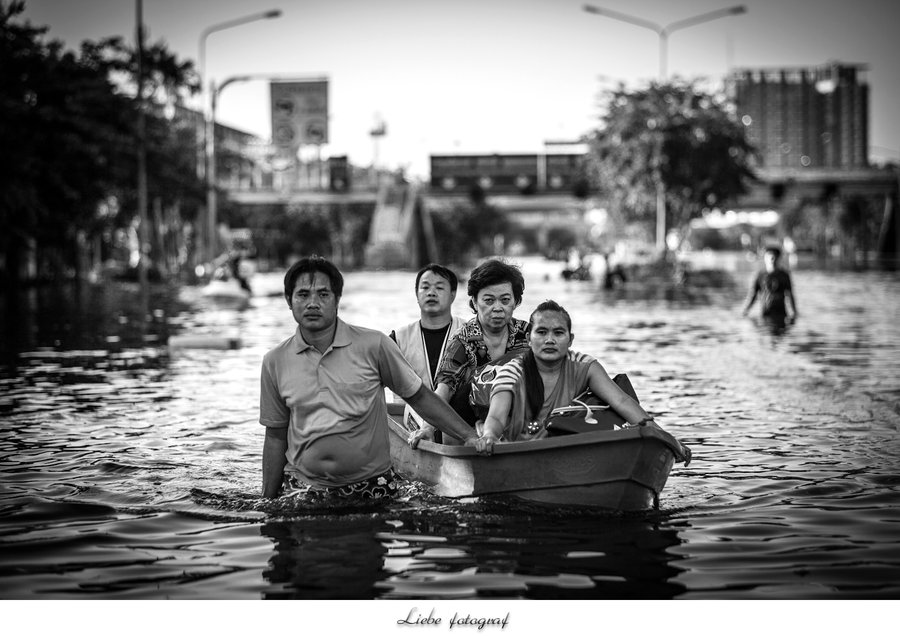
To those that can’t swim:
Summon wood and your spirits
It is time to build.
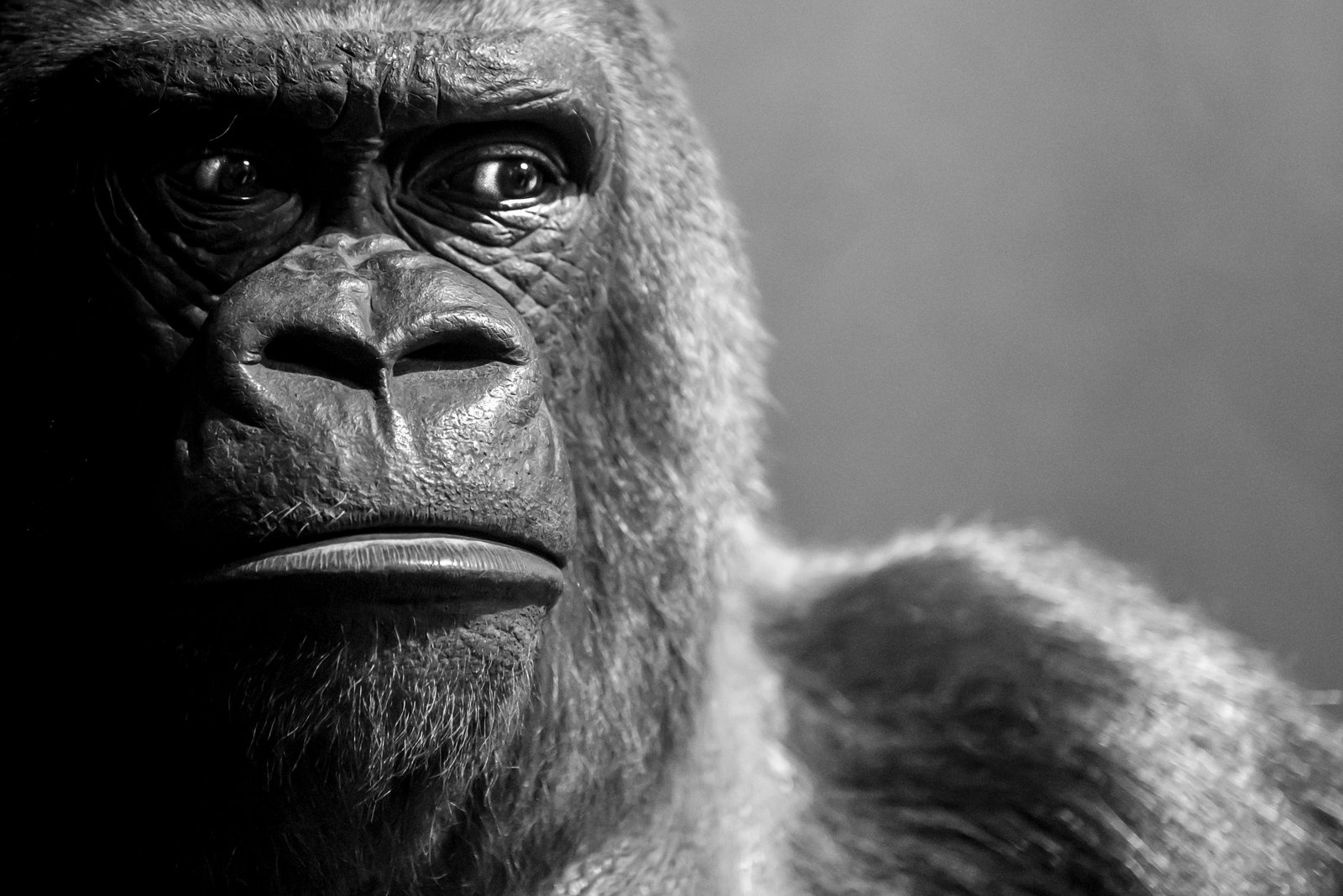
The King Gorilla
Sees only his usurpers
Scheming in the shade
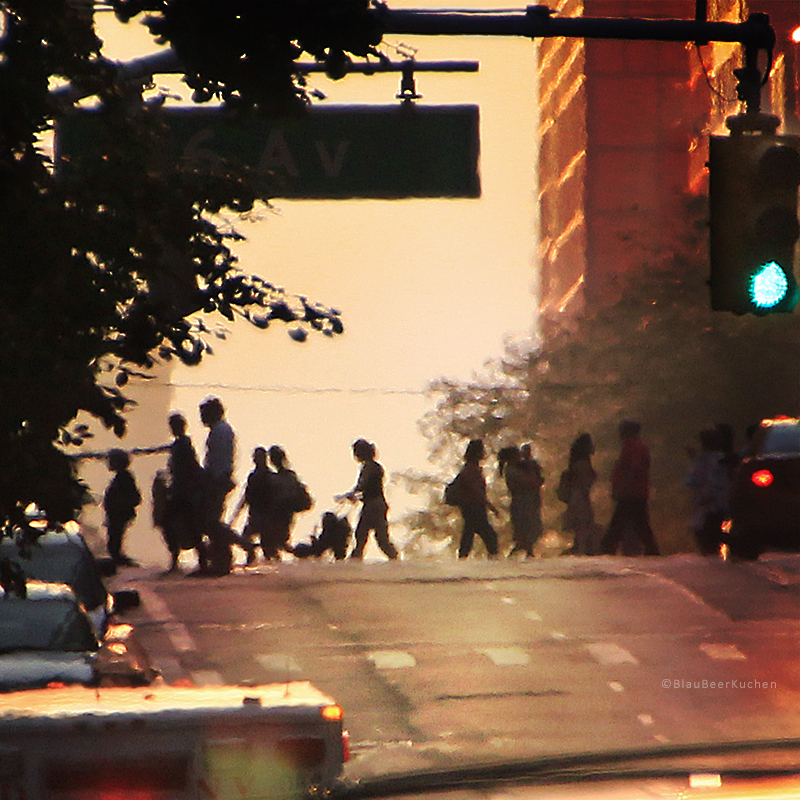
The air leaks water
Faces glisten and drop dew
Whole city sweating
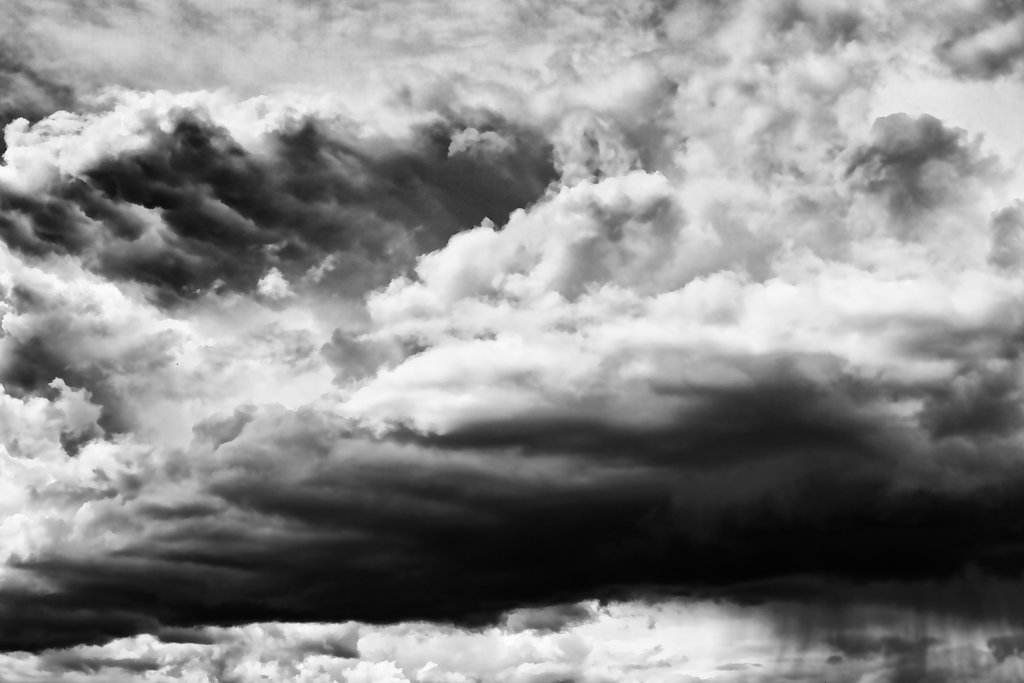
Before the sky breaks
She will protest and scream rain
She will sound the drums.
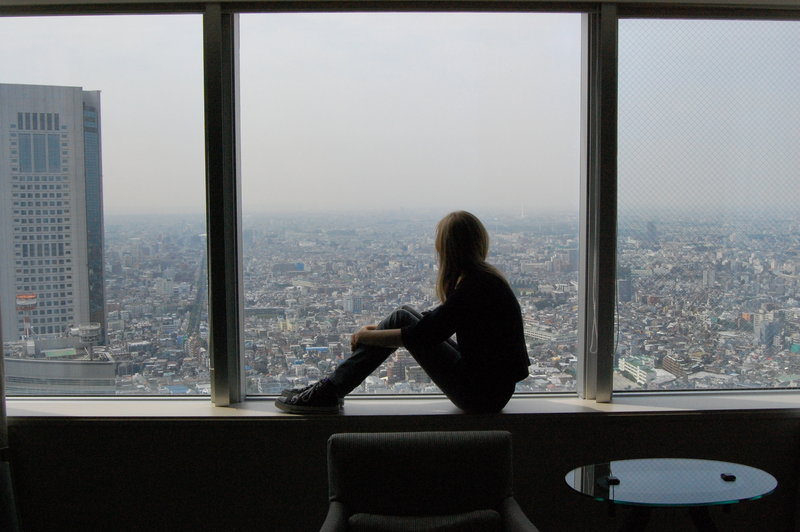
The ghost in transit
Lingers in sea and sky—Lost
Mind’s eye dimly lit
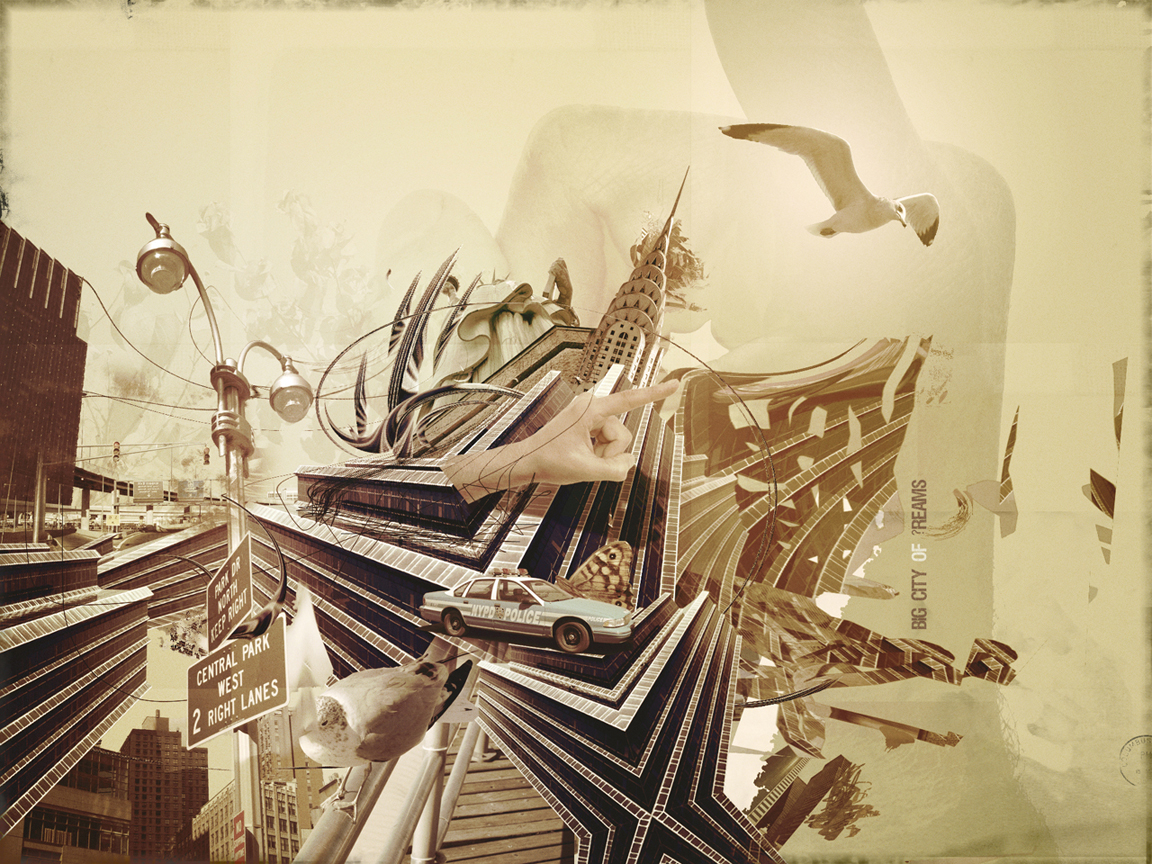
The only constant:
Man’s endless addiction to
Unfettered chaos
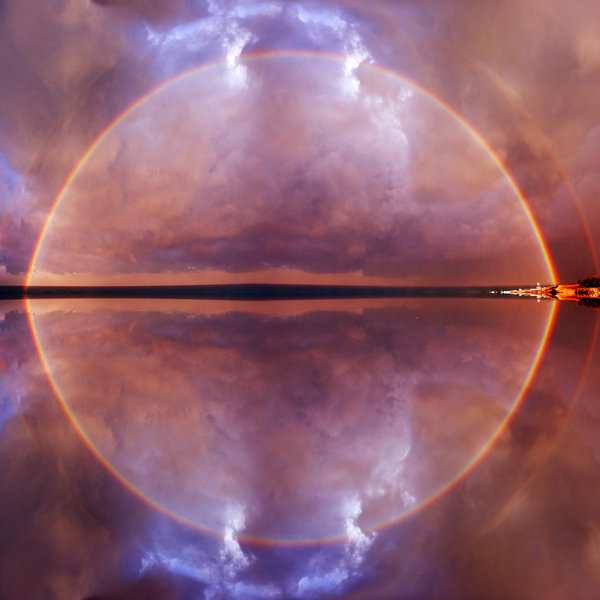
I know myself—
A slice of The Infinite
I know Nothing.
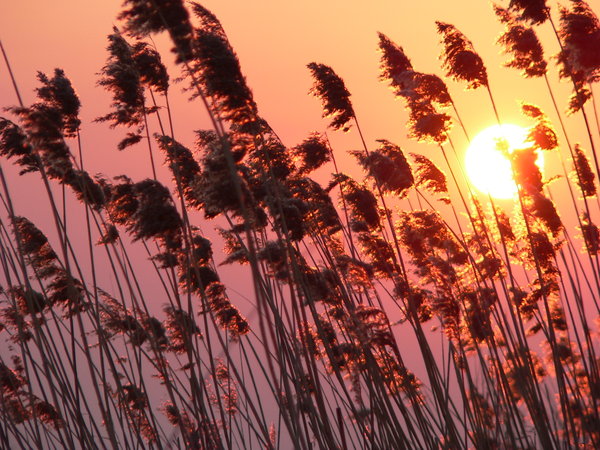
I often wonder
When the wind sweeps through your hair
Do you think of me?
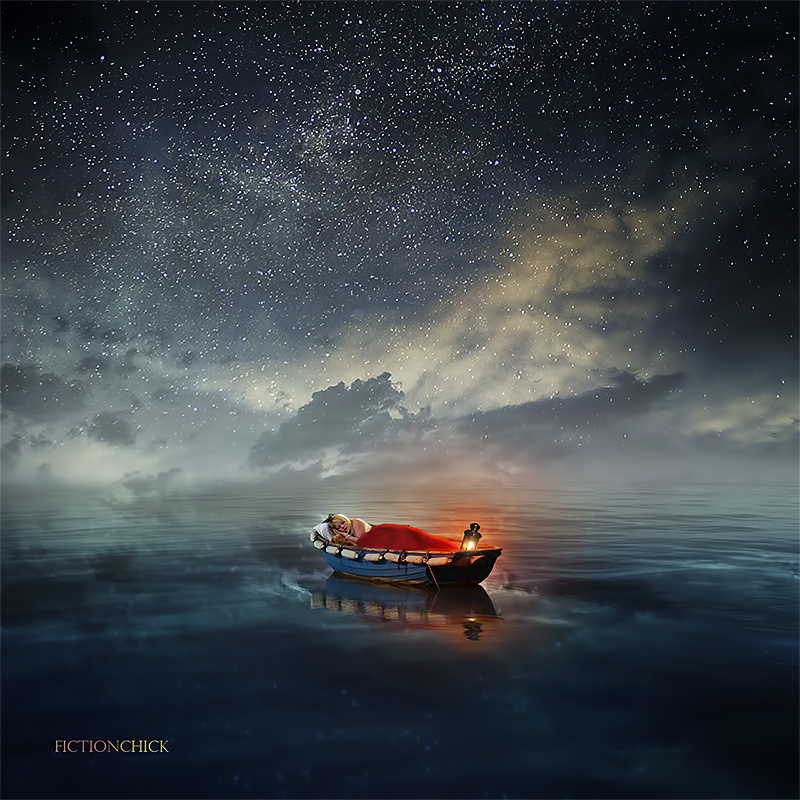
Sweet, saccharine sleep
Bring me to the other side
Send me down river.
It’s been almost three years since I’ve been to the make-believe part of my brain. Real life was more interesting than fiction in my eyes and, for the most part, still is. Even so, I’ve been meaning to come here again, and now that I’m back I’m realizing that I should have made the trip a lot sooner.
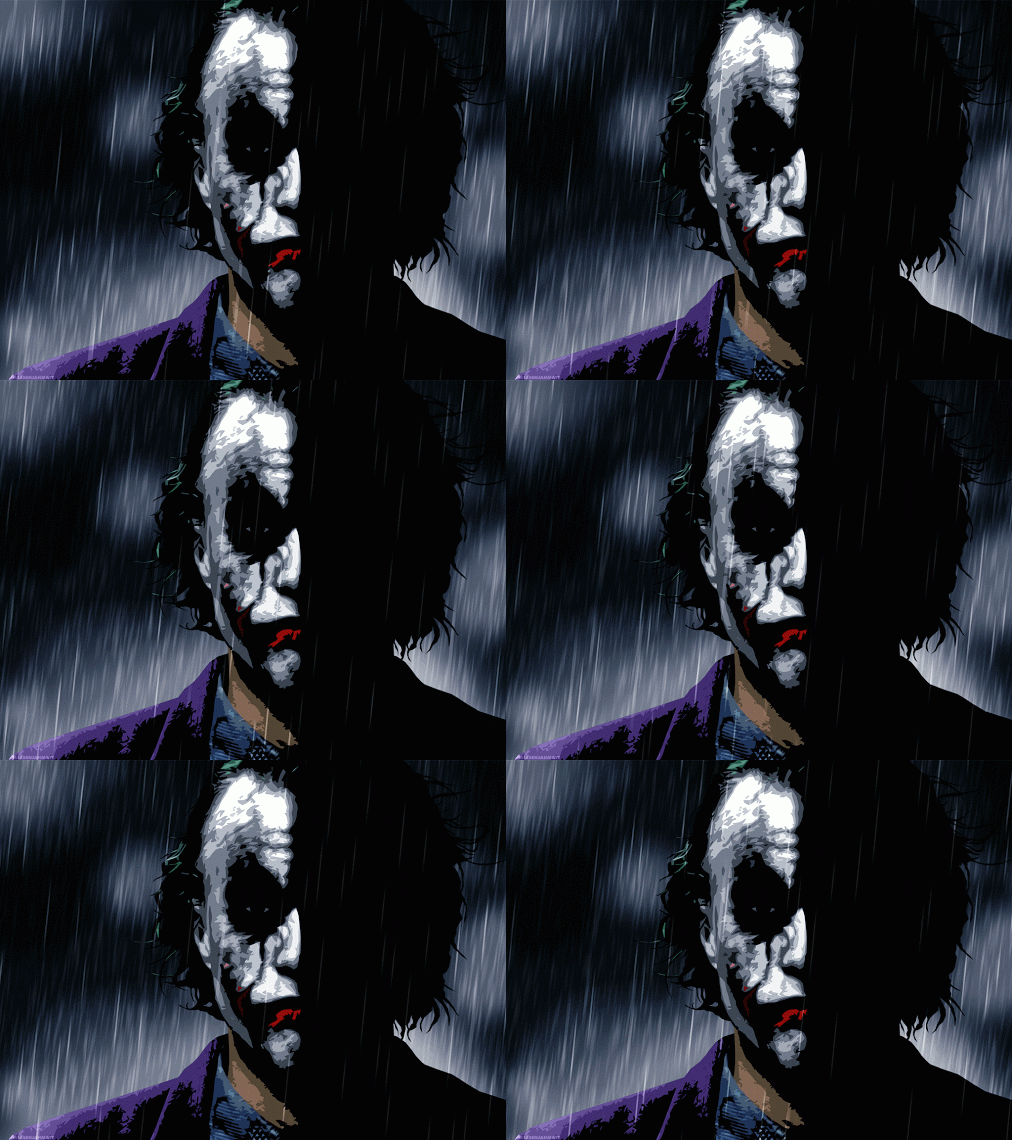
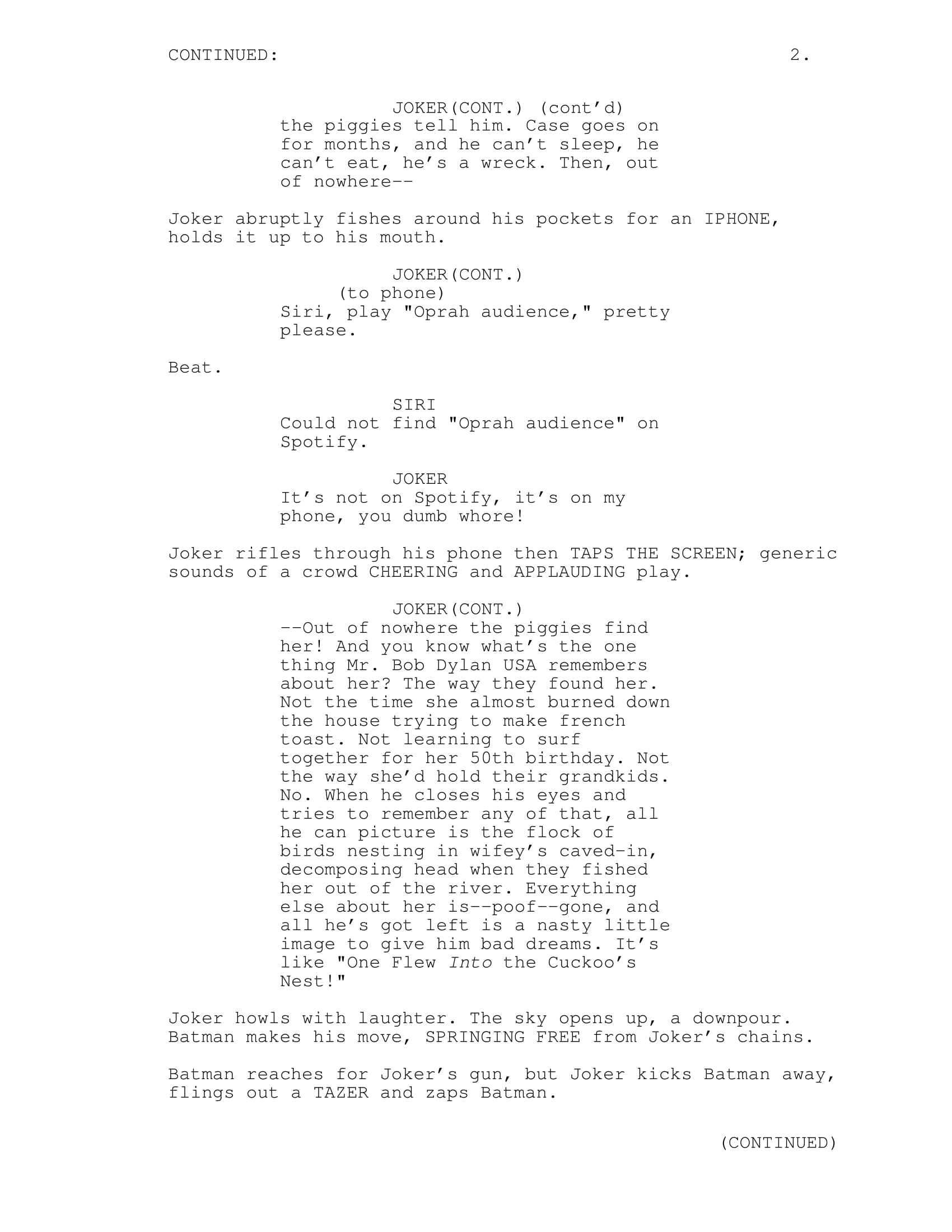
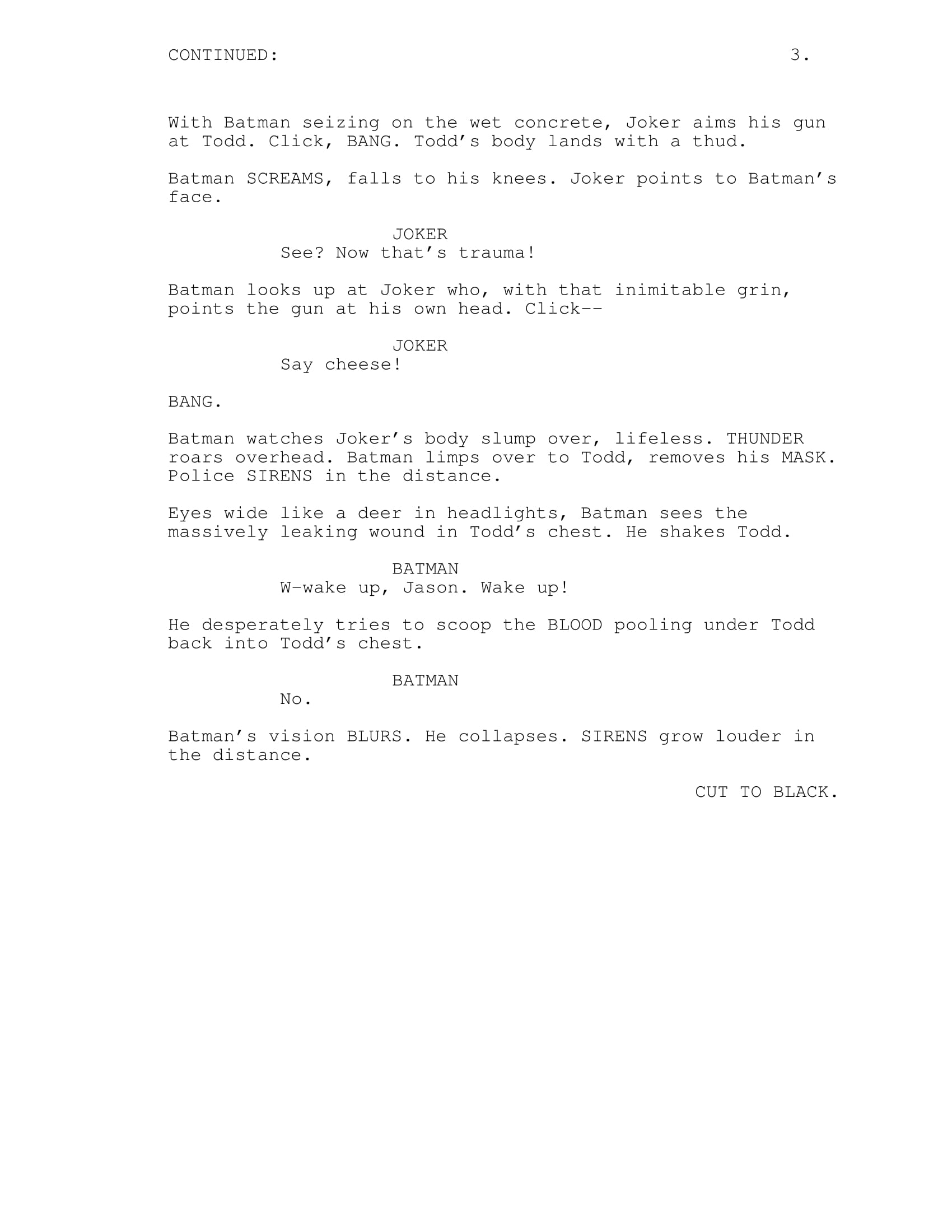
Let’s start with a screenplay adaptation of the 1988 comic Batman: A Death in the Family (Jim Starlin, illustrated by Jim Aparo), also known as “the one where Joker kills Robin.” The comic itself is awkwardly plotted and rife with bombastic dialogue, but it’s less known for its story than its ending, Robin’s murder at the hands of the Joker. I don’t like the comic. I think it’s too contrived, but the idea of Batman losing Robin and having to experience a kind of twisted sequel to his ultimate trauma, seeing his parents gunned down as a little boy, was fascinating to me.
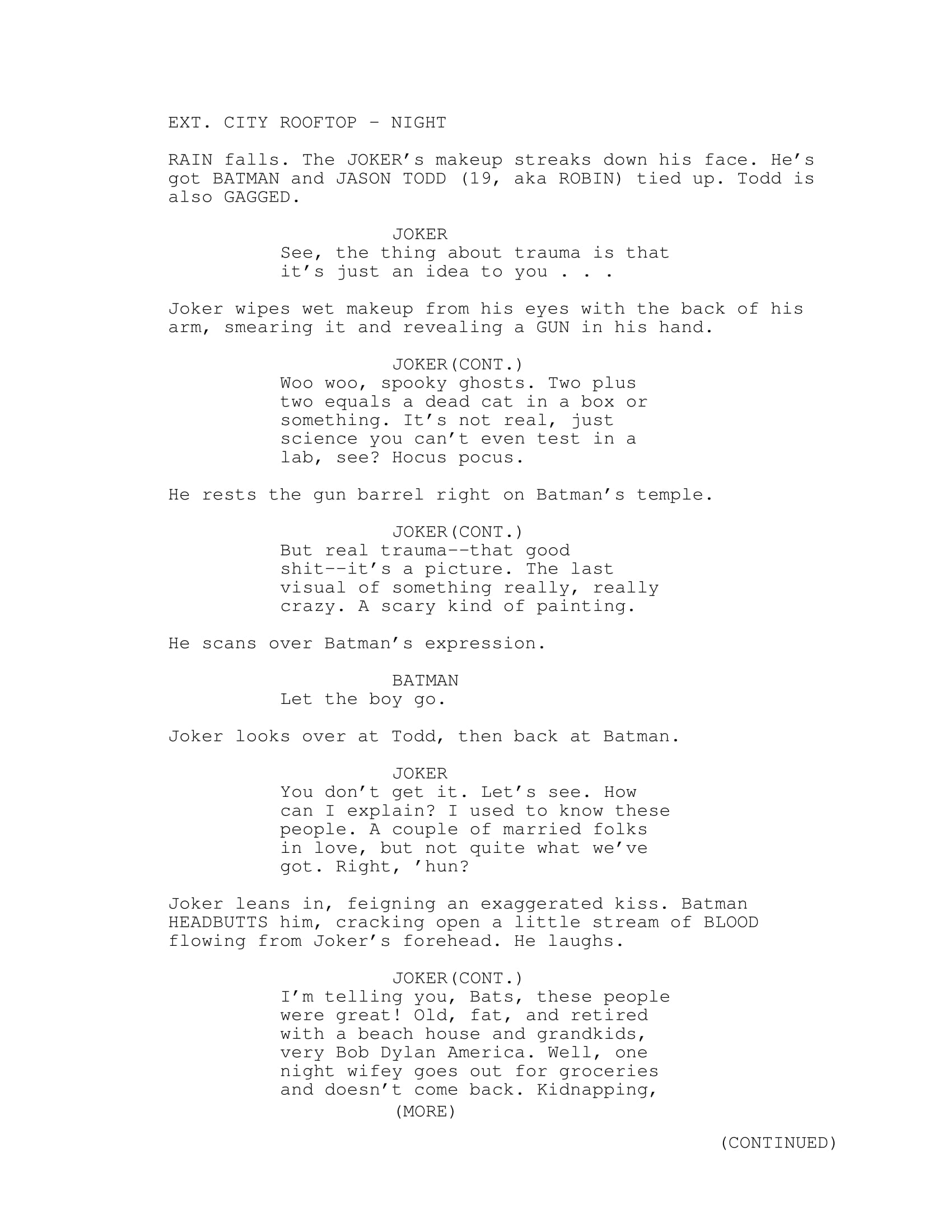
Instead of tell it through Batman’s eyes, though, I wanted to focus on the Joker. What’s his perspective on trauma? Has he ever gone through anything traumatic? How does trauma influence, or infect, his cryptic philosophy?
Anyways, here it is. It’s pretty short, a three page monologue.
Some ambient noise if you want to get in the mood (it rains in the scene):
 Just Writing